
How DO the Younger Generation Use AI?
Young people are diving headfirst into AI like it’s the latest social app, using it to learn, chat, and even argue with their fridge. Meanwhile, older adults are cautiously optimistic. They use AI by asking polite questions and wondering if it’s secretly judging their typing speed. Beneath the laughs, though, lies a real gap in how generations adapt to this tech shift; one sprinting ahead and dominating, the other trying to read the manual first.
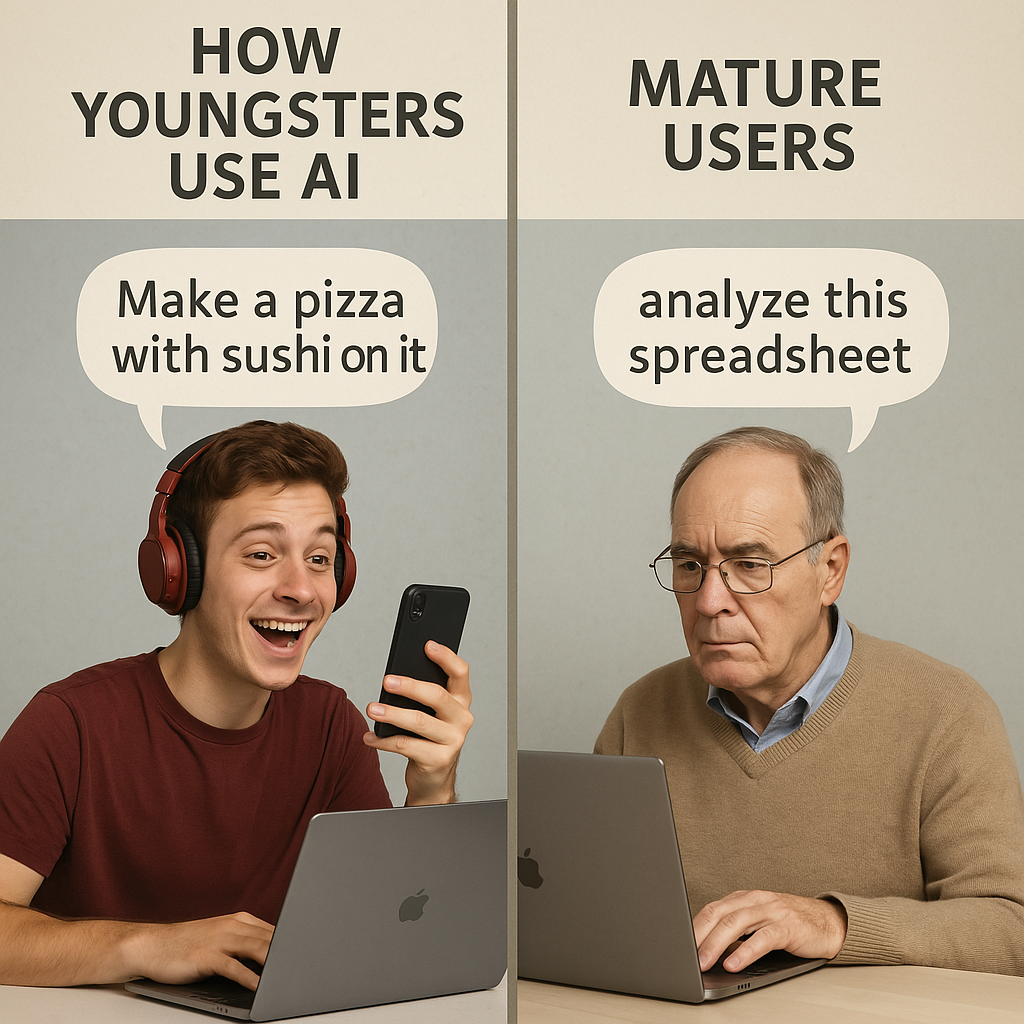
How Youngsters Use AI
Young people are diving head first into AI
But why do older folk like us hold ourselves back, treading carefully and always ready to fall back?

Transcript – How Youngsters Use AI
Lady AI: [00:00:00] Welcome back everyone to the deep dive. Today we’re gonna really get into something that’s changing so rapidly. Um, how different generations are using AI and. You know, the whole journey of information retrieval is fascinating and it kind of leads us right up to this moment. So we’ve got some, uh, really interesting reports to dive into today.
They look at, uh, people of all ages and how they’re interacting with ai. We’ve got some comparisons between the search methods you might be used to versus these new AI powered tools. And then we’ll wrap up with looking at what this all means for jobs in the future.
Sir Monocle: Yeah, it really is a huge shift and it seems like it’s happening so fast.
So what we’re trying to do today is understand the key differences in how, you know, younger and older adults are engaging with ai. Like what are people actually using it for? Yeah. And why We also wanna break down the strengths and weaknesses, both of that traditional search, you know, Google and these new AI tools.
And then we can’t avoid talking about the impact on society. Especially when it comes to employment.
Lady AI: Okay, so to kick things off, let’s talk about [00:01:00] this generational divide in AI adoption that we keep hearing about. And there’s one stat that really jumped out at me. Something like 79% of teenagers have at least tried out AI applications.
I.
Sir Monocle: Wow. Yeah. Which
Lady AI: is a lot. But then only 14% of older workers, you know, those 50 and up say they’ve used ai. So that right there is like a huge difference in how much people are engaging with this technology.
Sir Monocle: It really is a stark contrast and it kind of makes sense when you think about it. Like younger generations are growing up with AI as just a normal part of their digital world.
Yeah. But older adults might be encountering it much later. And maybe not even by choice. So yeah, it’s more than just the numbers though, like how are young people actually using AI in their day-to-day lives? What does that look like?
Lady AI: Well, it’s not even just teens, even younger kids are getting involved, which is interesting.
You’ve got 79% of those 13 to 17 year olds using things like chat, GPT, and image generators, and Snapchat. My ai, which we’ll get into more later, but even 40% of kids aged seven to 12 are using some form of ai. [00:02:00] So that’s a huge chunk of that younger age group too.
Sir Monocle: It’s pretty amazing when you think about it.
This tech is just becoming ingrained in their lives from such a young age. And you know, it’s often how it goes with tech adoption in general. You know, the younger generation picks it up first and then it starts spreading, but. The platform preferences are kind of interesting here. Snapchat, my AI seems to be the most popular with young people overall, like 50% are using it, but there’s this gender split.
Girls are using it way more than boys, and then boys are more into chat, GPT.
Lady AI: So it’s almost like AI is getting woven into their existing social habits, right? For girls, maybe Snapchat, my AI feels like a natural extension of just chatting with friends, but for boys that lean towards chat, GPT. Could that mean they’re approaching AI differently?
Like are they looking for information or trying to get specific tasks done?
Sir Monocle: That’s a good point, and it does make you wonder, you know, if. The interface and the social setting of these platforms really play a role in how different groups of people choose to use ai. [00:03:00] And it’s not just social stuff either.
When you look at educational use, the numbers are pretty crazy there, too. 44% of 16 to 24 year olds say they’re using AI to help with schoolwork.
Lady AI: Yeah, and there’s another interest in the STAT AI usage in that age group drops by 43% during the summer, so that really tells you a lot about how it’s being used.
Like it, it’s tied to their school year, so it’s not just a novelty for them. It seems like a genuine learning tool for a lot of students.
Sir Monocle: Yeah, that’s really fascinating. But here’s the thing that kinda surprised me. Even with all this AI use, young people aren’t just blindly accepting it. They’re actually pretty aware of the potential downsides, but two thirds of them say they’re concerned about what AI means for society as a whole.
Lady AI: I know that surprised me too. I would’ve thought that this generation, you know, growing up surrounded by technology, they just embrace AI without any hesitation, but it actually shows they’re thinking critically about it. Like they see that there could be some negative impacts down the line. That’s a good sign.
It makes you wonder though, if. Those early experiences might [00:04:00] shape how they see AI in the long run as they get older.
Sir Monocle: For sure. So, alright, let’s flip it and look at how older adults are approaching ai. Mm-hmm. Remember we said that overall adoption rate is much lower, only 14% using it regularly and the vast majority, like 80% say they rarely or never use it.
Yeah. I mean, does that match what you’re seeing out in the world? Like how different age groups are using tech?
Lady AI: Absolutely. But it looks like when they do use ai, it’s for very different reasons than younger people. It’s more about getting things done, you know, finding information, analyzing data, maybe creating content like writing emails or summarizing documents.
It seems like a much more professional context.
Sir Monocle: Yeah, it’s like a tool for them. Like they’re not exploring with it. They’re trying to get work done more efficiently, and a lot of it seems to come down to knowledge and familiarity. Only 42% of those over 50 feel like they really understand ai. And even fewer, like 31%.
Feel comfortable with it at work. So I think that lack of understanding is a big barrier to them using it [00:05:00] more.
Lady AI: It makes sense. If you don’t get how something works or what it can do for you, you’re probably not gonna use it. But the interesting thing is, almost half of older adults, 48% say they’d be interested in AI training.
So maybe it’s not that they’re against it, it’s just that there aren’t a lot of good learning opportunities out there that are tailored for them.
Sir Monocle: That’s a really good point.
Lady AI: Yeah.
Sir Monocle: And it tells us that. If we could offer the right kind of education and support, we could totally change how older adults engage with ai and their perspective on AI in general is actually pretty balanced.
About a third see it as both a potential problem and a potential opportunity,
Lady AI: which makes sense when you think about their life experience. They’ve seen how technology has changed things over the years, and when they think about the benefits of ai, it’s really focused on the workplace being more productive, making decisions faster, making their jobs easier.
It’s a pretty practical viewpoint.
Sir Monocle: So to sum up everything we’ve talked about so far, let’s directly compare how these two generations are actually using and thinking about ai.
Lady AI: Good idea. Okay. [00:06:00] So side by side, it’s really obvious that young people and older adults are using different platforms,
Sir Monocle: right?
Lady AI: Young people are all about Snapchat, my AI and chat GPT. While older AI users lean towards chat, GPT
Sir Monocle: and their reasons for using AI are totally different too. For young people, it’s usually about school or social interaction, but for older adults, it’s about finding specific information or analyzing data.
You know, for practical stuff.
Lady AI: And what about content creation? It seems like younger users are generating images for fun or trying out creative writing with ai. While older adults are more likely to be using it to write work emails or summarize reports,
Sir Monocle: and the way they’re using it is different too.
Like young people are using AI pretty consistently, maybe even daily, especially during the school year. But older adults are using it more sporadically just when they need it for a specific task. And of course the adoption rates themselves are drastically different.
Lady AI: Yeah, we already covered that. But their approach to learning about AI is also super different.
I. Young people [00:07:00] seem to figure it out on their own, maybe with their friends, but older adults are much more likely to want some kind of structured training to learn how to use AI effectively.
Sir Monocle: And lastly, their biggest concerns are different, which makes sense given their different stages of life. I. For young people, it’s about the big picture, like what does AI mean for society?
Right? What are the ethical implications? What are the long-term effects? But for older adults, they’re more worried about how it’s gonna affect their jobs. Like, are they gonna lose their jobs because of ai? And then there’s the concerns about data privacy and whether the information AI is giving them is actually accurate.
Lady AI: So it’s clear that these two generations are approaching AI from totally different angles shaped by their own experiences. But I think to fully understand what’s happening, we need to look back at how we used to find information online, like the whole evolution of search. It’s kind of wild to think about.
Sir Monocle: I know, right. It’s changed so much. So before Google was even a thing, [00:08:00] it was a completely different world online. Remember those hierarchical directories like Yahoo. Human Editors would organize websites into categories. It was like a giant digital library card catalog.
Lady AI: Yeah, I remember those. It was so organized and curated back then.
Sir Monocle: Mm-hmm.
Lady AI: And then the first search engines popped up like Alta Vista, Lycos, and Excite, but they were so basic. They just matched your keywords to words on websites without really understanding what you were looking for.
Sir Monocle: Right. You had to use the exact right words, or you’d get a bunch of irrelevant results.
It was like trying to find a needle in a haystack.
Lady AI: It definitely required some serious tech skills to navigate those early search engines. It felt like you needed to be in the know to even find the right information.
Sir Monocle: Yeah, it wasn’t very user friendly. And then Google came along and totally revolutionized everything.
They introduced this thing called the Page Rank Algorithm, which basically ranked websites based on how many other trustworthy sites were linking to them. Mm-hmm. It was kinda like a system of digital recommendations.
Lady AI: It was a game changer for sure. Suddenly, it wasn’t just about [00:09:00] categories anymore, it was about relevance and authority and the way they set it up.
You type in your keywords and you get a list of links ranked by relevance. That became the standard for over 20 years,
Sir Monocle: and you as the user. We’re expected to click through those links, figure out which websites had the best information, and then piece together the answer you were looking for yourself. It was like a self-serve information buffet,
Lady AI: and now things are changing again with the rise of AI search instead of those long lists of links.
We’re starting to get direct answers to our questions thanks to tools like chat, GPT.
Sir Monocle: Yeah, it’s like having a conversation. You ask a question in plain English and boom, the AI gives you a direct answer. Taking into account the context of your question, it’s like having a super smart assistant in your pocket.
Lady AI: Yeah, that back and forth is way more intuitive than trying to figure out the right keywords. It makes you think about how we interact with information and what we expect from these cert systems.
Sir Monocle: Totally. So. To help you navigate this new world, we need to weigh the pros and cons of [00:10:00] both traditional search like Google and this new AI powered search.
Let’s start with what’s still great about Google search. What does it offer that AI might not?
Lady AI: Well, first off, Google has this massive index of the entire internet, which is a huge advantage. It means you have access to tons of different sources, and more importantly, you can decide for yourself which ones are trustworthy.
You can see where the information’s coming from.
Sir Monocle: Yeah, that transparency is really valuable. You’re not just blindly trusting an algorithm. What else you got?
Lady AI: Another thing is Google search is really efficient when it comes to resources. Some research suggests that just one AI query can use way more energy than a typical Google search.
So when you scale that up to millions of searches a day, it could have a real impact on the environment. And let’s not forget, Google has spent years developing ways to filter out misinformation and identify reliable sources, especially for important topics like health and finance.
Sir Monocle: Those systems are really important, especially when you’re looking for accurate information you can trust.[00:11:00]
Now, let’s look at the other side. What are the big advantages of using AI search?
Lady AI: The most obvious one is you get instant answers. You don’t have to wade through a bunch of links and try to figure things out yourself. Plus the way you can talk to it makes it super easy to use and you can ask follow-up questions and it remembers what you were talking about before.
It’s like a huge step forward for how user-friendly searches,
Sir Monocle: right? That back and forth makes it feel much more human. It’s like you’re actually having a conversation to clarify what you mean.
Lady AI: Exactly. And AI is also better at understanding what you really mean even if you don’t use the perfect words.
And it can give you personalized results based on what you’ve searched for before. And for those really complicated questions that require information from tons of sources, AI can do all the heavy lifting for you and give you a nice summary.
Sir Monocle: That’s pretty powerful. So now that we’ve seen the good, let’s look at the downsides of both methods.
What are the things you should be aware of with Google search?
Lady AI: While having to go through all those links can take forever and it can be [00:12:00] hard to tell which sources are reliable and sometimes even if you’re using the right keywords. You might not find what you’re looking for. And then there’s SEO, which is basically people trying to manipulate their websites to show up higher in search results.
So sometimes it’s more about being popular than actually being helpful.
Sir Monocle: Yeah. And sometimes it can feel like you’re just talking to a machine. It’s not very personal. So what about AI search? What are the potential downsides there?
Lady AI: One of the biggest concerns is that AI can sometimes hallucinate. I. That’s when it gives you an answer that sounds really confident, but is completely wrong, and because it doesn’t always tell you where it got the information from, it’s hard to check if it’s accurate.
And also, AI’s knowledge is only as up to date as the data it was trained on, so sometimes it might not have the latest information.
Sir Monocle: We can’t forget about the resources it takes to run these massive AI systems.
Lady AI: Yeah,
Sir Monocle: the amount of energy they consume is something to think about.
Lady AI: And privacy is a big one too.
To give you those personalized results and make the conversation flow. AI might need to collect and use your data. [00:13:00] I. So we need to be really careful about how that data is being used.
Sir Monocle: So it’s not like one search method is better than the other. They both have their strengths and weaknesses. It’s all about choosing the right tool for the job.
Lady AI: Exactly. And all of this is having a huge impact on the job market, which is something we need to talk about, like call centers seem like they could be really affected by ai. As AI gets better at understanding natural language and answering questions, a lot of those customer service jobs could be automated.
Sir Monocle: It’s a real concern. There are millions of people around the world working in call centers, and these jobs are often concentrated in specific areas. So if AI starts replacing those jobs, it could have a big impact on those communities.
Lady AI: It’s a good example of how technology can have unintended consequences.
Like it can bring benefits, but it can also cause problems that we need to address. But it’s not all doom and gloom, is it? AI is also creating new jobs and requiring new skills.
Sir Monocle: Definitely. While some people might worry about AI taking over human interaction completely, a lot of people are excited about using AI [00:14:00] to make us better at what we do.
Like imagine AI tools for proofreading, creating tables from data or translating languages in real time. These tools could actually make human communication more efficient and effective.
Lady AI: So instead of replacing us completely, AI could help us do our jobs better,
Sir Monocle: right? And we’re already seeing new jobs pop up that are all about ai.
AI trainers, prompt engineers. Those are people who know how to write the best questions for AI and AI ethics specialists. These are jobs that require human skills to make sure AI is developed and used responsibly. It looks like in the future, humans and AI will be working together more and more.
Lady AI: So bringing it back to that generational divide we talked about before, these changes in the job market are gonna present different challenges and opportunities for different age groups.
Sir Monocle: Yeah, it could be a bit of a bumpy ride, especially with that huge gap in AI familiarity between younger and older workers. Remember, 79% of young people are using ai, but only 31% of older workers feel [00:15:00] comfortable with it in the workplace. That could make it hard for older workers to compete.
Lady AI: But remember, a lot of older workers are eager to learn about ai, so with the right training, they could adapt and thrive in this new environment.
Sir Monocle: Exactly. It’s not about replacing anyone, it’s about upskilling and reskilling. Older workers have so much experience and knowledge that’s valuable. If they can combine that with AI skills, it could make them even more valuable in the workforce.
Lady AI: Okay. We’ve covered a ton of information today. Let’s try to recap the main points for everyone.
Sir Monocle: So we started by looking at how different generations are using and thinking about ai. Young people are embracing it. Using it for school social stuff, and even just for fun, older adults are a bit more cautious using it mainly for practical tasks and to make their work easier. We also talked about how the way we search for information has totally changed over the years from those early directories to Google and now to AI assistance.
It’s been quite a journey.
Lady AI: And of course we had to talk about how all of this is affecting jobs. Some [00:16:00] jobs might disappear because of ai, but new ones are being created too, and it’s gonna require everyone to adapt and learn new skills.
Sir Monocle: And remember, these generational differences aren’t just about ai.
They’re about how we learn how we work, and how we see technology in general. Yeah, these trends are gonna have a big impact on how we design and develop AI in the future.
Lady AI: It seems like the future of finding information isn’t gonna be about picking one method over the other. It’s about being smart and using both traditional search and AI search depending on what you need.
We all need to learn how to do that.
Sir Monocle: And when it comes to jobs, we need to be proactive about training and re-skilling people so they can thrive in this new world. We need to figure out how to integrate AI in a way that benefits everyone and doesn’t leave anyone behind.
Lady AI: So to wrap things up, here’s something to think about.
How do you find information online? And how do you feel about ai? Do you think it’s a good thing or a bad thing? And as AI becomes more and more a part of our lives, how are you going to adapt? Think about how you learn, how you work, and how you [00:17:00] interact with the digital world. Thanks for listening to the deep dive.